


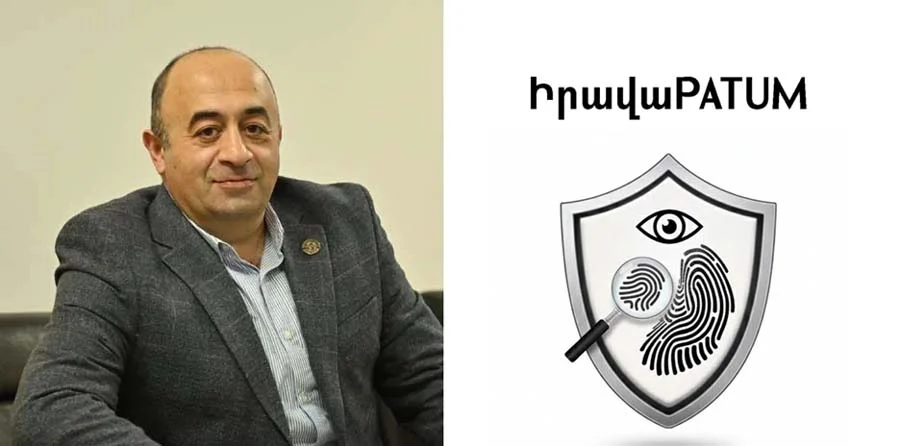
We look not for people, but for what they have buried. The stories presented in the series “The Detective Investigates” are based on real cases investigated by Hayk Gabrielyan, Chairman of the Association of Private Detectives of Armenia, and Gabrielyan & Partners Detective Bureau, Armenia’s only officially registered private detective organisation. Every Friday, Aravot publishes the detective’s unique revelations.
In the late 1980s the Soviet Union still seemed unshakeable, but it was already crumbling from within. People left for all kinds of reasons — to work, to live, to survive. In those years many destinies became intertwined, only to be lost later among the years, the distances and human pain.
In 2024 we were contacted by a client from Ukraine, Ruslan. From his voice it was immediately clear this was no ordinary story. He had been approached by the team of the Ukrainian programme “Wait for Me”. A young woman was looking for her father. Her name was Oksana, and she was thirty-five. She was searching for a father who, according to her mother, came from Armenia. According to the information available, the father was from Armenia. In the late eighties he worked in Ukraine, where he met the girl’s mother.
The mother became pregnant, and the father returned to Armenia. Soon afterwards the devastating 1988 earthquake struck. Contact was lost. The girl was born in 1989. Her mother tried to tell the father about the birth by telegram, but never received a reply. The mother died in 1994. Oksana was raised by her grandmother. For years she carried this story with her. She worked as a nurse and had never seen her father, but all her life she tried to imagine him.
There was almost no information. The Ukrainian birth certificate gave the father’s first name and surname — in a garbled form. There was an approximate year of birth, somewhere between 1947 and 1953. No address, no photograph, no names of relatives. Only the fact that he came from the disaster zone. Almost nothing. But in detective work, that is often exactly when the real struggle begins: when logic says the search is next to impossible, yet something inside tells you to keep going.
We started searching. About 150 people matched that name, surname and age range. Long, exhausting work began: social networks, old profiles, phone directories, cemeteries, connections, workplaces. In Armenia there were no results. This investigation showed us once again that people often underestimate the value of digital traces. Many make fun of the social network Odnoklassniki, but in this case it turned out to be the key that opened the door. On an old Odnoklassniki profile, one man caught my attention. Born in the disaster zone. The profile had entries linked to Russia. And most importantly, the Russian spelling of his name was very close to the version recorded in the Ukrainian birth certificate.
With the help of our Russian partners we began the identification process. For days we examined every detail: old addresses, workplaces, consular records, photographs. Every new fact brought us closer to the truth. And then came the moment when we all fell silent for a few seconds. The man was alive. What’s more, he had not been living in Armenia after independence — he was already working in Russia. So he had not died. The telegram sent by the girl’s mother had never reached him.
It was sent a few months after the earthquake, when Armenia’s communications were practically paralysed. In those days thousands of letters and telegrams simply vanished. He had never known he had a daughter. And so two people lived in different countries for another thirty-five years, knowing nothing of each other’s existence.
When our Russian partner contacted the man and told him that a young woman from Ukraine was looking for her biological father, there was a long silence on the line. The kind of silence that sometimes says more than words. Then came a heavy, broken voice: “Are you telling me I have had a daughter all my life and knew nothing about it…” At that moment no one in our team said a word.
We arranged their first video call a few days later. On one side of the screen was a woman who had searched for her father all her life. On the other, an elderly man seeing his daughter for the first time. At first they did not speak. They just looked at each other. She was crying. He tried to hold himself together, but could not. Then he said quietly: “If only I had known, my life would have been different…” But the most moving part of the story was still to come.
By then the war had already started. There was no direct travel between Ukraine and Russia. The borders were closed; from the very beginning the client had tried to arrange a meeting between father and daughter, but even simple human ties had become entangled with politics. And I realised that if this story had come this far, we had no right to leave it unfinished. We decided to arrange their meeting in Armenia — the country where, many years earlier, a telegram that never arrived had started this whole sad story.
Zvartnots Airport had its usual atmosphere: people waiting, people embracing. But each of us in the team felt a special tension. First we met Oksana. Looking at her, I understood that a whole life had gathered inside her at that moment: fear, pain, hope, longing, waiting. She was visibly nervous all the way and tried to hide it. There were about five hours until her father’s flight landed. We suggested that Oksana come into Yerevan with us, walk around a little and then return to the airport to meet him. A few hours later we were back at the airport, Oksana with us.
Her father appeared in the distance. He had aged. His step had grown a little heavy — the mark of hard years. But his eyes were the same. The very eyes the girl had tried to picture in her mind for thirty-five years. They rushed towards each other. For the first few minutes no one could speak. It was as if both were afraid to believe it was real. Then she said quietly: “Dad…” And at that word her father broke down. He held his daughter tightly and sobbed.
Only people who realise that life has taken their most precious years and their dearest people cry like that. They stood embracing in the middle of the airport for a long time. People came and went around them, announcements rang out, life went on at its usual pace, but at that moment it felt as if the whole world had stopped.
I watched from the side and thought about one simple thing. A detective’s work is not only about finding people. Sometimes we give people back a lost part of their own lives. We give back a connection they never even knew existed. Somewhere, for many years, someone kept searching for them, and they never knew. The 1988 earthquake destroyed thousands of lives.
Hayk GABRIELYAN
Aravot daily
15.05.2026
Read at the source (in Armenian): The telegram that never arrived