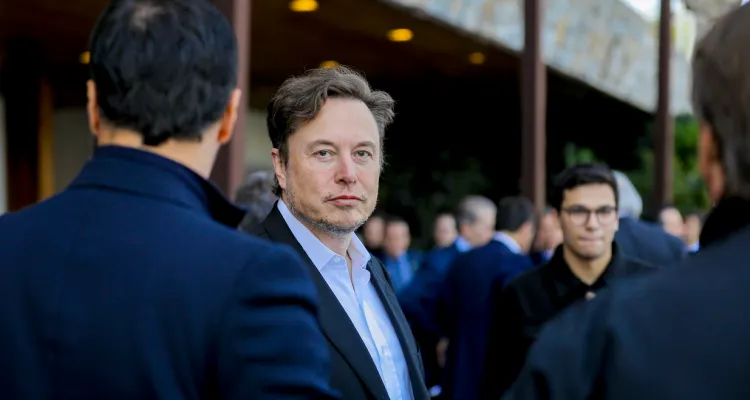
In 2017 and 2018, when some workers were trying to unionise at Tesla’s factory in Fremont, California, Elon Musk’s electric car company paid the consultancy MWW PR to monitor employees in a Facebook group and keep a closer eye on social media, according to invoices and other documents reported by CNBC.
According to documents describing the work, two things MWW PR watched closely were discussions of unfair labour practices at Tesla and a sexual harassment lawsuit.
Although the records of Tesla’s online monitoring of employees are years old, they have new relevance for observers trying to better understand CEO Elon Musk’s priorities regarding social media.
Musk recently struck a 44-billion-dollar deal to buy Twitter, the social network he has relied on for years to promote his companies and mock or criticise perceived enemies, including short sellers, whistleblowers, the UAW, journalists and Democratic elected officials. He is expected to become Twitter’s interim CEO if the deal closes.
The records show Tesla paid MWW PR to monitor Tesla employees on Facebook for comments about organising efforts and to research specific organisers.
At the time, Tesla’s director of global communications, Dave Arnold, had ties to the PR and consulting firm the carmaker hired for the work. He had worked at MWW for about four years, from 2011 to 2015, as a vice president, and before that served as communications director for former congressman Anthony Weiner (D-N.Y.), according to an MWW press release announcing his hiring.
Tesla and Elon Musk have clashed with union supporters for years. In 2017 Tesla fired a union activist named Richard Ortiz, and in 2018 Musk posted a tweet that was found to violate federal labour law. The National Labor Relations Board ordered Tesla to reinstate Ortiz and to require Musk to delete the tweet, which it said threatened workers’ compensation. Tesla appealed the administrative ruling, and the tweet stayed up.
Musk has criticised many Democratic elected officials, including President Joe Biden, for their pro-union views. He recently said he plans to vote Republican in the upcoming elections because “the Democratic Party is overly controlled by unions” and class-action lawyers. Tesla’s plants in Texas and California have never held a union election.
A spokesperson for MWW PR told CNBC:
“MWW advised Tesla in 2017–2018 on broad employee engagement during a period of rapid company growth. It is common practice to analyse media coverage and public social conversations about a company to understand stakeholders’ concerns and perceptions of the brand.”
Arnold and Tesla did not respond to requests for comment.
“Social listening” versus surveillance
According to John Villasenor, a professor at UCLA and a fellow at the Brookings Institution whose research focuses on the impact of technology on society, law and public policy, companies have good reasons to keep track of what their employees post online.
He said: “Suppose you have an employee who goes online and publicly posts all kinds of racist statements. You could argue it would be in the company’s interest to know that. If a person says something that directly bears on their fitness for the job, you would want to know, and you can’t just say it’s none of our business.”
Villasenor noted that there are also clear ethical lines that should not be crossed when it comes to accessing employees’ social media profiles and posts.
Jennifer M. Grygiel, an associate professor at Syracuse University whose research focuses on propaganda and social media, told CNBC that companies should refrain from any actions that violate workers’ rights, especially their right to discuss, form or join a union.
“Any organisation can engage in ‘social listening’, using publicly available social media data to inform product development or understand constituents, public and employee sentiment and much more,” Grygiel said. “But in the US there are laws protecting people’s right to organise. If you’re a PR agency or a manager who has to infiltrate a semi-private group? That’s not fair. And I doubt Tesla would send a PR firm to find out how to support workers who are organising.”
Three people who were Tesla employees in Fremont in 2018 told CNBC that colleagues had warned them not to connect with their supervisors on social media and not to join Tesla employee groups on social media unless they knew everyone in the group, including the administrator. Two others who work at the company today said employees assume Tesla closely monitors their social media posts.
Internally, employees communicate in several channels, including Mattermost (an open-source chat product) and Teams (Microsoft’s video conferencing platform), but Tesla does not use Facebook Workplace and did not use it in 2018.
Tesla’s current communications policy, obtained by CNBC, says managers should not access subordinates’ social media pages unless there is a clear business reason to do so. The policy also discourages employees from speaking out online about work issues and cautions:
“You are more likely to resolve work-related issues by speaking directly with your co-workers, supervisor or other management personnel, contacting your HR partner or using the Tesla Integrity Line than by posting your concerns online.”
Read at the source (in Russian): https://bit.ly/3bzgZb7